

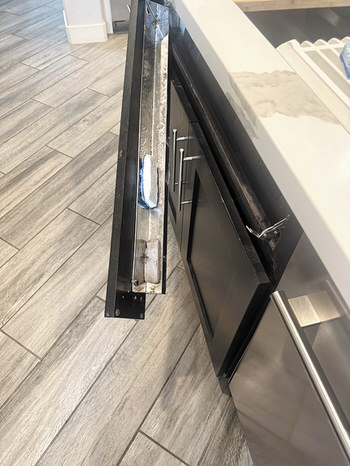
A resident project was completed in
May when a kitchen sponge drop-down
drawer had loosened from its cabinet.
Club President John Hardin and member
David Petty repaired the drawer.
Michelle Kouri
During our last SaddleBrooke Woodworkers Club meeting, member Doug Kouri gave the club’s first Safety Presentation, which will now become a quarterly agenda item.
Remember when sometimes you say you cannot hear your wife, partner, or whoever … especially when “they” are walking away from you? Here are a few reasons to consider:
* First, women’s voices are at a different pitch than men’s, thus possibly making it harder for a man to hear a woman’s voice.
* Throughout our lives, we are inundated with varying levels of noise exposure. It starts early with loud car radios blasting away—something many of us still enjoy today, especially when listening to good old ’60s and ’70s music.
* Then there are shop noises. Doug and his wife measured the decibel levels (dBA) from the operator’s position of typical equipment in their home-state, very large shop (which now must be in a small SaddleBrooke golf cart garage):
Decibel (dBA) Levels
12” Two-speed band sawing soft wood: 90
12” Two-speed band saw: 79
Radial arm saw: 87
Radial arm saw cutting soft wood: 104
Band saw: 80
Band saw cutting soft wood: 94
Shop Vac “Quiet” mode: 75
Shop Vac old model: 85
Lathe: 80
Grinding wheel for sharpening tools: 81
Porter cable sander: 89
Stereo (normal sound level): 79
Normal conversation is about 60 dBA. A running motorcycle engine is about 95 dBA. Newer, high-end dishwashers range from 38 to 45 dBA. Older models are higher. Noise above 70 dBA over a prolonged period of time may start to damage your hearing. Loud noise above 120 dBA can cause immediate harm to your ears. Ear muffs are strongly encouraged when reaching higher levels.
Sound intensity is the amount of sound energy in a confined space. So if your shop is a standard or golf cart garage, sounds may be more damaging when in close proximity to the tool.
NIOSH has developed a dataset of sound power levels (LWA), hand-arm vibration levels m/s2.
The purpose of the dataset is to provide the necessary information for tool purchasers to buy “quiet.” Additional information can be found on the CDC website by searching topics related to tool noise, hearing protection, and noise exposure levels. Smart and android phones’ noise apps may not be accurate comparisons. Users need to do further research.
By the time this article is published, all 12 Preserve Clubhouse tables have been returned to their assigned rooms. Pictures and a more detailed article highlighting the refinishing project will be published soon.
Another resident project was completed in May when a kitchen sponge drop-down drawer had loosened from its cabinet. Club President John Hardin and member David Petty repaired the drawer and restored it to working order, much to the delight of homeowner Andrea Waterhouse, who made a generous donation to the club in appreciation for their work.
Check us out on sbwoodworkers.org.