
 Mary Jo Bellner Swartzberg
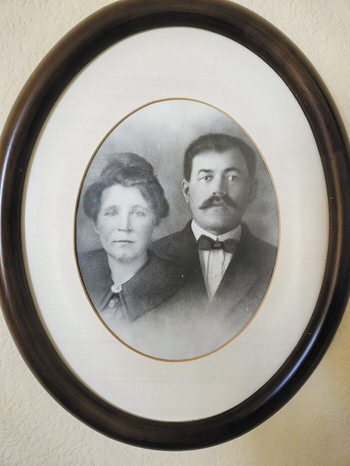
There is a very old black and beige (having originally been white, but decades have darkened the white color) photo of my maternal grandparents hanging in our guest bedroom. They both immigrated from Poland but died in 1919 during the devastating flu pandemic. What lives they could have had were it not for their untimely deaths.
My mother, the second youngest of six children, was four years old when her parents passed. She and her only three brothers would be sent to a Catholic orphanage. Her eldest sister was taken in by a neighbor, and the youngest sister (who was only 18 months old) was taken in by an aunt. This would be unheard of today without legal intervention.
I have often looked at my grandparents’ photo, especially seeing Grandmother Anastasia with her upswept hair and a brooch at the neckline of her conservative black dress, and I think: I have t same uneven ears and the same wispy, thin hair. Handsome, mustachioed Grandfather Stanislaus was dressed in a formal jacket with a stiff collar and a bowtie. And I cannot help but notice that I have my grandfather’s eyes.
My paternal grandmother died years prior to my birth; hence, I only had one grandparent—my paternal grandfather. But I did know some of my paternal great-aunts and uncles.
Still, I wish I could return to my younger self and talk to my maternal and paternal great-aunts, great-uncles, aunts, and uncles to ask questions of them. Now, being in my 70s, I wish I’d had the opportunity to explore what their lives were like in the latter part of the 19th century and during the early part of the 20th century and beyond. What a trove of familial and historical information they could share. And, of course, these octogenarians would have enjoyed sharing their lives with me!
I cannot say that I am “haunted” by my inaction for not doing a deep dive into my ancestral past. But what I can say is that perhaps I was too self-absorbed in college, my career, and dating to take an interest in my elders. And this I do regret. Unfortunately, in their passing, their beautiful histories have been largely lost, especially if these relatives did not have children.
However, I, like all other children and young adults, believed that everything would remain static in life until I began to see changes in my personal world. The inevitable sickness and death of my family elders slowly emerged to punctuate their lives with a period. For life, like a sentence, will have an endpoint.
Perhaps Alex Haley (author of Roots) said it best: “In every conceivable manner, the family is [a] link to our past, [a] bridge to our future.” Indeed, family and time are inexorably connected with history, providing a “foundation for the future.”
Share this article with your children and grandchildren.