

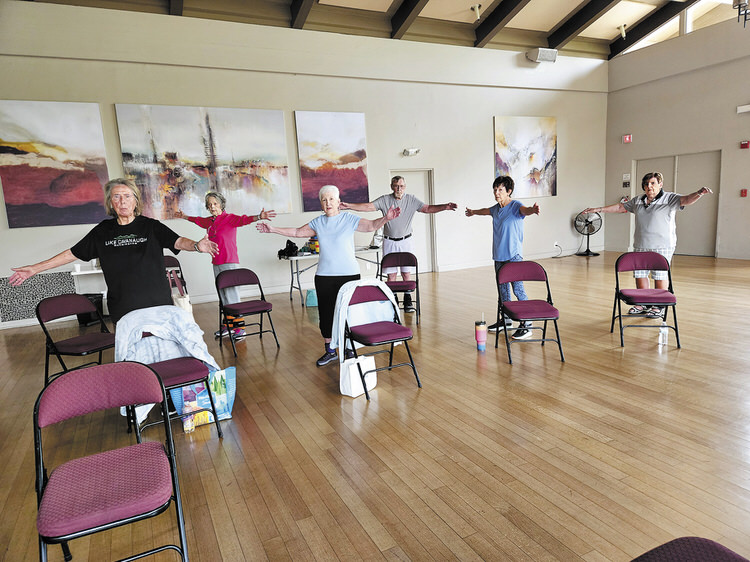
Practicing posture with open arms
Vera Shury
Temporary Class Location: Vermillion Room 1 to 2:30 p.m.
What we are missing in our variety of equipment we are making up with more spacious movements and agility routines as shown in our Photos.
The Augmented Feedback program is a hybrid of combining strategic words to help increase the benefit of exercise and voice volume, and there will be some equipment that provides feedback to show success.
“Parkinson’s disease (PD) impairs the brain’s ability to process sensory feedback, such as vocal effort and volume, causing a mismatch between what the person perceives and what others hear.
Vocal Function Exercises must be done at a high enough level of effort to strengthen muscles,” notes Mary Spremulli, CCC-SLP, voiceaerobicsdvd.com.
This mismatch also happens in movement; the perception by the person is bigger than the actual movement. By adding verbal cues during the movement, motor initiation is enhanced by engaging both the auditory motor networks and the cognitive motor planning regions of the brain. Spatial mismatch is included in gait and curb step down application.
Self-generated vocal cues help to increase the speed of reaction and perform daily tasks faster and smoother than before, without using cues.
Feedback is an essential component of training and recovery. Varied feedback shifts the focus from external to using more internal feedback and can help members fine tune and enhance their awareness and control.
Acceptance for the need for behavioral change comes with “Oppositional Defiance.” Proof of benefit including feeling and seeing improvement eases that process of making a new behavior a habit.